


Richmond Park Associates FZCO is incorporated in IFZA with registered office at Silicon Oasis, DDP, IFZA Business Park, 25333-001, Dubai (RPA FZCO). Richmond Park Associates Limited is incorporated in Masdar with registered office at Smart Station, First Floor, Incubator Building, Masdar City, Abu Dhabi (RPA Ltd). RPA Ltd is registered with, and regulated by, the UAE Ministry of Justice. Together, RPA FZCO and RPA Ltd comprise the RPA group of companies established in the UAE.
Recent events in and around the Strait of Hormuz have shown how quickly a maritime route can become legally sensitive. For owners, managers, lenders, insurers and advisers dealing with high-value maritime assets, risk is no longer assessed only by looking at title documents or corporate ownership. In a volatile geopolitical environment, route, flag, destination, use, ownership, control and sanctions exposure may all become relevant at the same time.
The law of armed conflict at sea and domestic sanctions enforcement remain distinct regimes. One concerns naval warfare, blockade and capture. The other concerns blocked property, asset-freeze measures and sanctions evasion. In practice, however, the same yacht may attract scrutiny under both sanctions analysis and broader maritime security considerations, particularly where it is linked to a sanctioned person, a high-risk jurisdiction or a sensitive maritime route.
Two regimes, one exposed asset class
The law of naval warfare may determine a vessel’s character by reference to flag, registration, ownership, charter or other criteria. OFAC, in a different context, similarly looks beyond formal title when assessing whether a purported transfer or divestiture was genuine. The legal tools differ, but the practical direction is comparable: the paperwork is only one part of the picture.
The interception of M/V TOUSKA on 19 April 2026 shows how quickly that analysis can become operational. According to CENTCOM, the Iranian-flagged vessel was intercepted while sailing towards Bandar Abbas, Iran, and was disabled and boarded after repeated warnings that it was violating U.S. blockade measures. CENTCOM also stated that, since the blockade’s commencement, U.S. forces had directed 25 commercial vessels to turn around or return to an Iranian port.
In an armed-conflict context, and without treating sanctions exposure as determinative, the San Remo Manual illustrates how flag, destination and vessel character may become legally significant. Depending on the circumstances, those factors may affect whether capture is available without prior visit and search.
The point is not that every vessel transiting a sensitive area is exposed to the same consequences. It is that, in a restricted maritime environment, the legal characterisation of a vessel can become decisive very quickly.
As noted in our earlier brief article on OFAC’s March 2026 sham-transaction guidance, the same concern for substance over form runs through sanctions enforcement. A transfer that exists on paper will not necessarily extinguish a blocked interest if the blocked person continues to control, use or benefit from the asset. The red flags identified by OFAC, and the consequences of getting that analysis wrong, are set out in detail in that note.
Why this matters for yachts
This matters for yachts because they are not static assets. A superyacht is not a cargo vessel and will not ordinarily be the subject of naval interdiction. But yachts share several features that make them sensitive to sanctions and, in exceptional circumstances, wider maritime security risk. They are mobile across jurisdictions, often held through layered structures, financed and insured by regulated institutions, and capable of being used by individuals whose sanctions status may be contested or may change without notice.
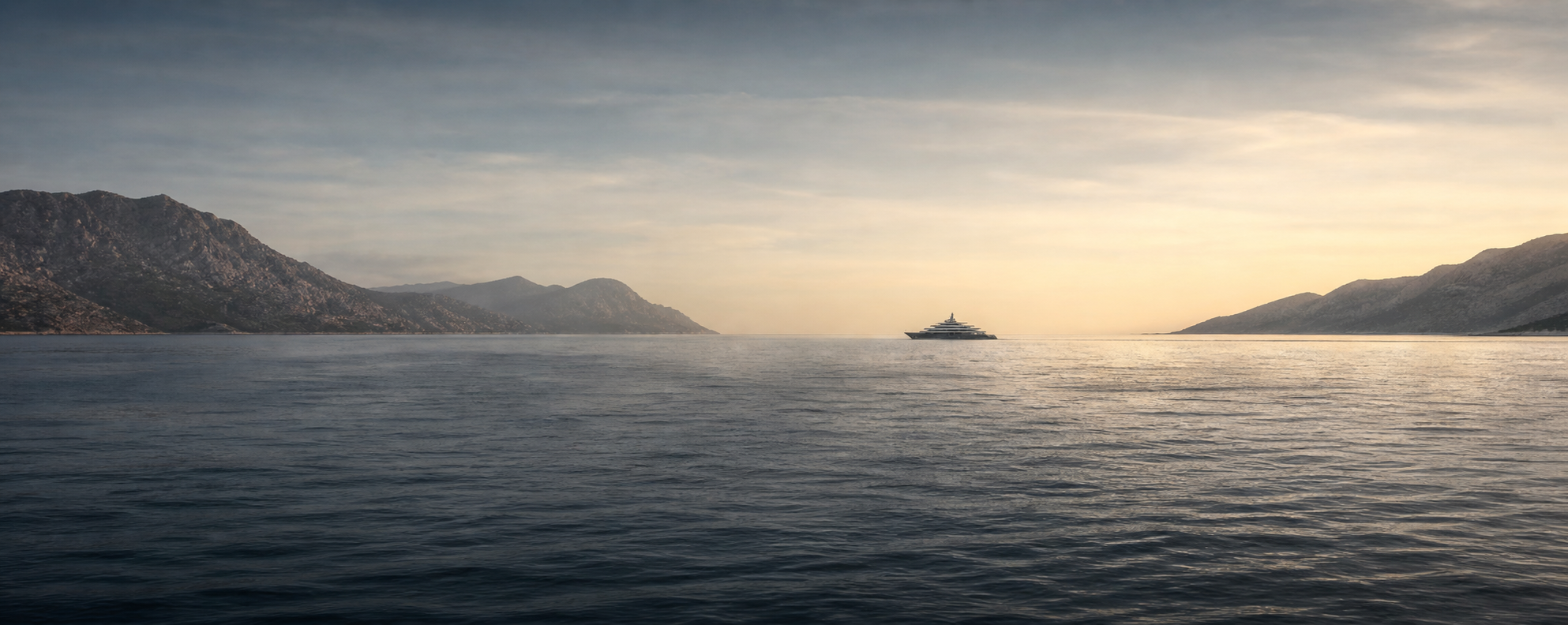
The recent passage of the superyacht Nord through the Strait of Hormuz illustrates the point in a yachting context. According to Reuters, the 142-metre yacht, linked to a sanctioned Russian businessman, crossed the Strait after leaving Dubai and reaching Muscat, Oman. The same reporting noted that the individual is not formally listed as the yacht’s owner, but that shipping data and Russian corporate records showed the vessel was registered in 2022 to a Russian company owned by his wife. In a subsequent report, citing a source close to the individual, Reuters stated that Nord crossed on an approved route, that neither Iran nor the United States objected to its passage, and that the yacht did not call at Iranian ports or have any connection to Iran.
That fact pattern is materially different from TOUSKA. Nord was not an Iranian-flagged cargo vessel attempting to reach an Iranian port. It was not treated in the same way, and no interdiction occurred. But it is precisely the kind of example that matters for the yachting sector: a high-value yacht, linked to a sanctioned individual, moving through a geopolitically sensitive maritime area where assumptions about navigation, access, banking, insurance and enforcement may no longer be straightforward.
If movement is questioned, the risk is wider than detention
For most yachting clients, the more realistic concern is not military interdiction. It is the commercial and regulatory disruption that may follow once a yacht is treated as connected to a blocked person, a sanctioned jurisdiction, a high-risk ownership structure or a sensitive route.
If a yacht is stopped, delayed or questioned, the analysis will not be limited to its physical movement. Authorities and counterparties may ask who owns it, who controls it, who funds it, who uses it, who gave the relevant instructions, whether any sanctioned person continues to benefit from it, and whether recent transfers or management changes were genuine.
This is where sanctions law and sham-transaction risk become directly relevant. Sophisticated ownership arrangements, including special purpose vehicles (SPVs), trusts, management companies and flag changes, are entirely legitimate in normal circumstances. The difficulty arises when those structures are tested against sanctions substance, asset-freeze principles or broader maritime risk. At that point, it is not enough to show that the documents are in order. The structure must also make sense in practice.
The consequences can arise without a dramatic enforcement action. Insurers may restrict cover, banks may delay payments, lenders may freeze facilities, marinas may decline access, and managers, brokers, captains, yards or other service providers may need to consider whether they can continue to deal with the asset.
The Nord passage is useful precisely because no interdiction occurred. It shows that even an uneventful transit may raise questions where route, sanctions exposure and reported ownership links intersect. In this environment, the absence of detention does not necessarily mean the absence of legal risk.
What this means in practice
The TOUSKA incident, the passage of Nord and OFAC’s sham-transaction advisory are legally distinct, but together they illustrate a broader risk environment for high-value maritime assets. In that environment, route, flag, destination, sanctions status, ownership, control, use and source of funds may all become relevant to the same legal and operational assessment.
For yachting clients and their advisers, the question is therefore not only whether a structure is legally valid. It is whether the yacht’s ownership, use and movement would withstand scrutiny from a court, regulator, bank, insurer or enforcement authority applying a substance-based analysis. For sanctions and asset-freeze purposes, that scrutiny is now a practical concern.
In practice, this means monitoring not only ownership structures, but also movement strategy. Route planning, port calls, maintenance stops, flag issues, payment flows, insurance arrangements and management instructions may all become legally relevant where a yacht is linked, directly or indirectly, to a sanctioned person or a high-risk jurisdiction.
Our firm advises on the intersection of maritime law, sanctions compliance, asset-freeze measures and high-value yacht structuring. We continue to monitor geopolitical and regulatory developments for clients with complex cross-border maritime interests.
Sources: